
How to Tell if a Tree is Dangerous: Warning Signs Gold Coast Homeowners Should Know
A healthy tree adds value, shade and character to any Gold Coast property. But trees can develop structural problems that aren't always obvious from the outside, and by the time the signs are clear, the risk is already significant. Here are the warning signs to look for, including some specific to the palms and subtropical species common across the region.
1. A Sudden or New Lean
A tree that has always grown at a slight angle is not necessarily a concern. Trees that lean over time develop what is called reaction wood, which helps them adjust to the lean and stay stable.
A sudden lean is a different matter entirely. If a tree that was previously upright has started to lean, or if you notice the lean has changed recently, it usually means something has happened to the root system. Check the ground around the base of the tree. If the soil looks disturbed, raised or cracked, the roots may be pulling out. This tree needs to be assessed immediately.
2. Dead or Hanging Branches
Dead branches, particularly large ones, are one of the most common causes of property damage and injury. They are sometimes called widow-makers, and for good reason. A dead branch can remain attached to a tree for years, with decay spreading inward to the live tissue, before it eventually fails.
Look for:
Branches with no leaves during the growing season when the rest of the tree is healthy
Branches that look dry, brittle or discoloured compared to the rest of the canopy
Hanging branches that have partially broken but not yet fallen
Branches caught in the canopy of other trees
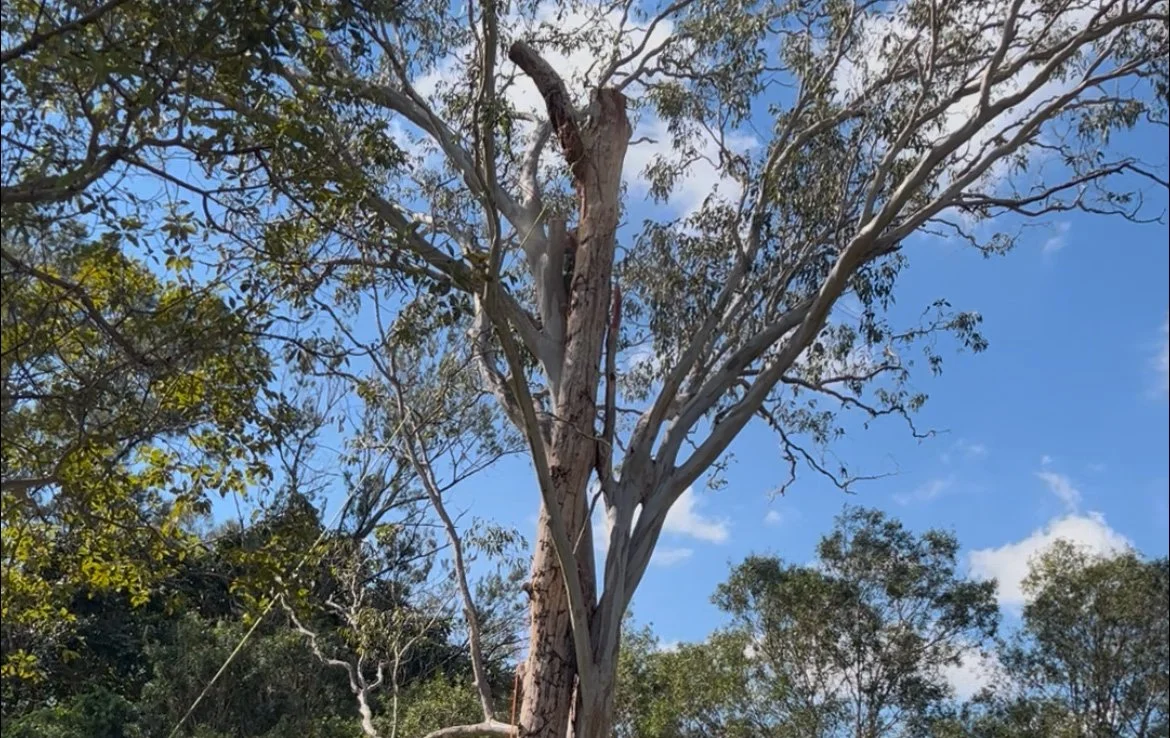
Even more concerning than a dead branch is an entirely dead tree. On a recent job in Tallai, we found a dead, termite-damaged tree leaning against a healthy tree, which you can see in the image above. Once we climbed up to inspect it properly, we discovered that the dead tree had begun causing decay in the healthy tree as well. Left alone, it was only a matter of time before one or both failed.
The trees were in a backyard where the family’s children regularly played, so they needed to be removed immediately. Had the dead tree been dealt with earlier, the healthy tree may have been able to be saved. Instead, both had become a hidden risk to the family and their property.
It was one of those jobs where the danger wasn’t obvious from the ground, but the consequences could have been serious. We were very glad to leave knowing we had removed the risk before something went wrong.
3. Cracks and Splits in the Trunk
Deep cracks in the trunk are a sign of structural weakness. The trunk is what holds the tree together under load, and fractures reduce its ability to do that. Cracks tend to worsen over time, particularly under the stress of high winds during a Gold Coast storm.
Pay particular attention to:
Vertical cracks running along the trunk, especially if they appear on opposite sides
Splits at the point where two or more stems branch off from the trunk
V-shaped forks where two stems grow very close together and bark becomes trapped between them. These are significantly weaker than a normal U-shaped fork and are prone to splitting under load
4. Fungal Growth, Mushrooms or Conks
Mushrooms growing at the base of a tree, or shelf-like fungal growths called conks on the trunk, are not just cosmetic. They are a telling sign of internal decay. Fungi feed on wood, and by the time they are visible on the outside of the tree, the decay inside is usually already well advanced.
In the Gold Coast's humid subtropical climate, fungal decay progresses faster than it does in cooler, drier parts of the country. A tree showing these signs should be assessed by a qualified arborist before the next storm season.
5. Cankers and Damaged Bark
A canker is an area of sunken, discoloured or missing bark on the trunk or a major branch. They are usually caused by disease or by wound tissue that has failed to seal properly after an injury. The damage visible on the outside of the bark is often a sign of more extensive decay underneath.
Look for areas where the bark looks wrong compared to the rest of the tree. Soft or crumbling wood when you press on it, hollow sounds when you knock on the trunk, and holes or cavities in the trunk are all signs that decay has taken hold inside.
6. Root Damage and Soil Disturbance
The root system is the foundation of the tree, and root damage is one of the most serious problems a tree can have. The problem is that roots are underground and damage often isn't visible until it's well progressed.
Signs to watch for at ground level:
Raised or cracked soil around the base of the tree
Exposed roots that have been cut, damaged or disturbed by construction, trenching or paving
Roots growing under concrete or pavers, which can indicate the root system is compressed or stressed
Soft or waterlogged ground around the base after dry weather, which can indicate root rot
Gold Coast properties with sandy coastal soils are particularly vulnerable. Sandy soils provide less anchoring for root systems than heavier clay soils, and trees in these conditions can be more susceptible to leaning or uprooting in strong winds.
7. Warning Signs Specific to Palm Trees
Palms are one of the defining features of the Gold Coast landscape, but they have their own set of risk factors that are different from hardwood trees.
Frond discolouration and die-back
Healthy palms produce green, upright fronds. Yellowing, browning or wilting fronds that start at the crown and work downward can indicate disease, nutrient deficiency or root problems. Frond die-back that affects the newest growth at the centre of the crown is particularly concerning and can indicate a serious disease affecting the growing tip.
A leaning or tilting crown
Unlike hardwood trees, a palm's trunk is not rigid in the same way. But if the crown of a mature palm is visibly tilting or the trunk has developed a pronounced lean that was not there before, the root system may be compromised. This is particularly common after nearby construction work or after periods of heavy rain.
Soft or damaged trunk tissue
Press gently on the trunk at various points. A healthy palm trunk should be firm. Soft spots, sunken areas or visible damage to the trunk, particularly at the base, can indicate internal rot. Palms with significant trunk damage are at real risk of snapping rather than uprooting in a storm, which is why the damage is often less predictable.
Fronds not dropping cleanly
Old fronds should drop away from the tree cleanly as they die. If dead fronds are accumulating and not shedding, this can increase the weight of the crown and how much it catches the wind, making the tree more vulnerable during a storm.
When to Call an Arborist
Not every tree showing one of these signs needs to be removed. Some issues can be managed with pruning, some require ongoing monitoring, and some require removal. The only way to know for certain is to have a qualified arborist assess the tree in person.
If you notice any of the warning signs above, it is worth getting a professional opinion sooner rather than later. A tree risk assessment gives you a clear picture of what the tree is doing and what needs to be done about it.
The Good Wood Co. provides tree risk assessments and tree removal services across the Gold Coast. If a tree on your property is giving you concern, get in touch for a free quote.